
Case study: a custom CMM inspection fixture printed in Rizium CF
Prymetech printed a 10.2 × 7.1 × 5.3 in fixture for a heavy, complex metal part in Rizium CF. It holds the part within ± 0.001 in across inspection cycles and went from design to use in about 2 to 3 days.
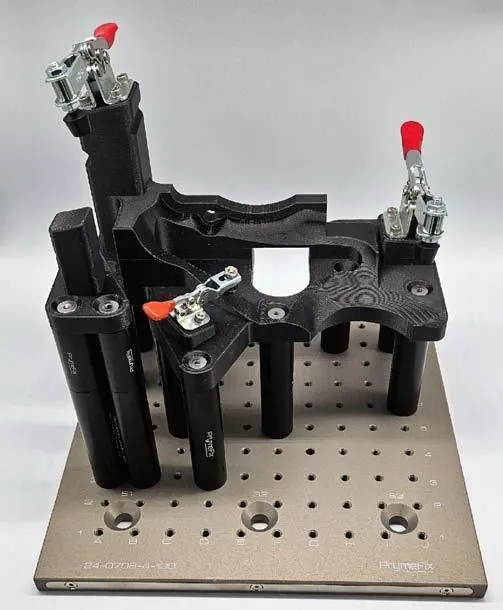
Company: Prymetech, metrology and quality control · Application: custom fixture for coordinate measuring machine (CMM) inspection · Material: Rizium CF · Printer: XRIZE, with release ink
The challenge
Prymetech has provided turnkey quality control solutions since 2009, with a machine shop, a quality lab and an engineering team. A large part of its work is custom fixtures that hold parts on CMMs and other metrology equipment. Customers usually need them quickly and on a limited budget.
This project needed a fixture to cradle a large, heavy metal component with complex geometry during CMM inspection. The fixture had to:
- carry the weight of a production metal part,
- follow its complex contours accurately,
- hold it in the same position on every cycle, so measurements repeat,
- be ready within a short lead time.
Machining the shape would have meant long programming and setup, a lot of material removed as waste, and waiting for machine time. Common 3D printing materials such as PLA, PETG and ABS were not strong enough for the load.
Why Rizium CF
Prymetech’s experience with a range of printing materials is that carbon and glass fiber filled filaments hold up better than unfilled thermoplastics. It chose Rizium CF for four reasons: strength to carry a heavy part, durability in daily handling, consistent print quality and dimensions, and a black finish that meets its standard for delivered fixtures.
How it was printed
| Parameter | Value |
|---|---|
| Printer | XRIZE, with release ink |
| Material | Rizium CF |
| Fixture size | 10.2 × 7.1 × 5.3 in |
| Infill | 100% |
| Print time | 63 hours |
| Material used | 736 g |
| Supports | minimal, released with ink |
| Post-processing | virtually none |
Release ink made it simple to take the part off the build plate and its supports, with almost no cleanup. A lower infill would probably have worked, but it was not tested.
The fixture needed threads for mounting hardware. Prymetech tapped them directly into printed holes in Rizium CF without problems, then combined the printed parts with standard modular fixturing components to build the finished fixture.
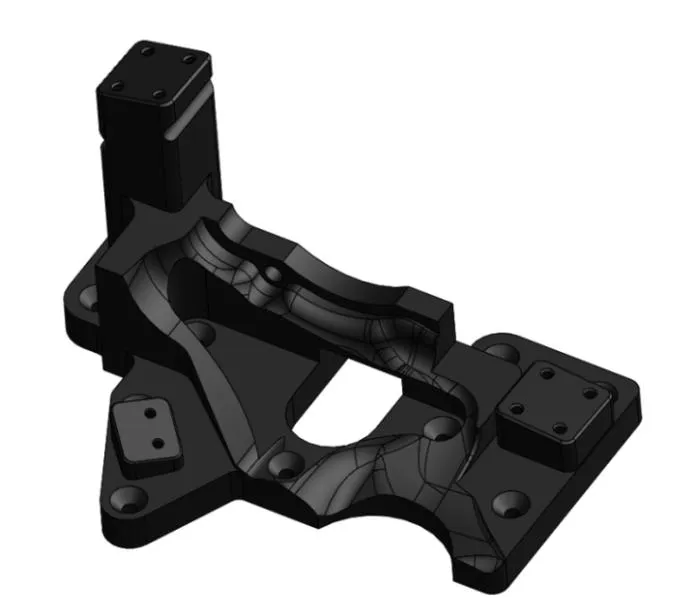
Printing changed the design approach. Instead of simplifying the geometry to suit machining, Prymetech designed contours that match the supported part closely. Supports that release cleanly removed another set of design constraints.
Results
| Measurement | Result |
|---|---|
| Overall dimensional tolerance | ± 0.005 in |
| Internal diameters | print up to 0.010 in undersize; corrected by adjusting the design or by reaming |
| Measurement repeatability | holds the part within ± 0.001 in across cycles |
Lead time. The print itself ran 63 hours, longer than the roughly 16 hours of machine time a CNC version would need. But printing needed almost no setup or programming, started the same day without waiting for machine time, and ran overnight and over the weekend without an operator. Total lead time was about 2 to 3 days, compared with several days to weeks for machining.
Fast changes. During assembly, one support leg needed a design change. The new version was printed overnight and added almost no delay. With machining, the same change could have cost several days of scheduling, tool changes and setup.
Lighter to handle. The printed fixture is much lighter than an equivalent aluminum or steel design, which reduces operator fatigue and injury risk when it is lifted onto and off the CMM.
“3D printing has changed the game for us. Rizium Carbon Fiber allowed us to manufacture this fixture in days rather than weeks, keeping our customer happy.”
Alex Klein, Design Engineer, Prymetech
What Prymetech does next time
With more projects on the system, Prymetech is cutting print time further by adjusting layer height, using less support material through better part orientation and design, and considering printing earlier in the design process.
Materials and data
Rizium CF is a carbon fiber filled cyclic olefin copolymer (COC) blend for FFF printers with a hardened nozzle. Measured properties, print settings, the technical data sheet and the safety data sheet are on the Materials page. Rizium filament is sold through the Niche 3D Store.
The case study was prepared by Prymetech and is summarized here with its permission. Photos: Prymetech.