APD technology

Augmented Polymer Deposition

APD is a hybrid 3D printing process. Functional inks jetted onto each extruded layer change the part exactly where they land.

Extrude, jet, repeat

  1. Extrude. The extruder deposits a flat layer of the base polymer, for the part and for any supports.
  2. Jet. The printhead passes over the fresh layer, in both directions, and places each functional ink on the cells that need it.
  3. Repeat. The next layer bonds to the inked layer below. Curved shapes are built from flat layers of different extent.
  4. Release. When the build is done, the supports separate from the part along the release ink.
How APD builds a part, layer by layerSide cross-section of a curved part being printed. Every layer is flat; the curve is built from layers of different length. Supports below are flat layers of the same material. Release ink sits where supports meet the part, bonding ink between part layers, and color on the cells that form the surface. An extruder deposits the current layer and a piezo printhead jets ink onto it.ColorReleaseBondingSurfaceYour ink123456
  1. 1Extruder deposits a flat polymer layer
  2. 2Piezo printhead jets functional inks from separate reservoirs onto the fresh layer
  3. 3Color and marking at and just below the surface
  4. 4Ink between layers for bonding
  5. 5Release ink where supports meet the part
  6. 6Supports: flat layers, same material
Cross-section during printing. Dashed outlines are layers still to be printed. "Your ink" stands for a new functional ink developed with a partner. Diagram, layer height exaggerated.

The technology stack

Materials, software and hardware, designed together

Materials

Rizium thermoplastic composites as the base polymer, and functional inks for color, marking, release, bonding and surface.

Software

A voxel-based slicer decides, layer by layer, where the polymer goes and which ink lands on which cell.

Hardware

A hybrid head: thermoplastic extrusion plus a piezo printhead fed from separate ink reservoirs, registered to each other.

Demonstrated today

Five capabilities

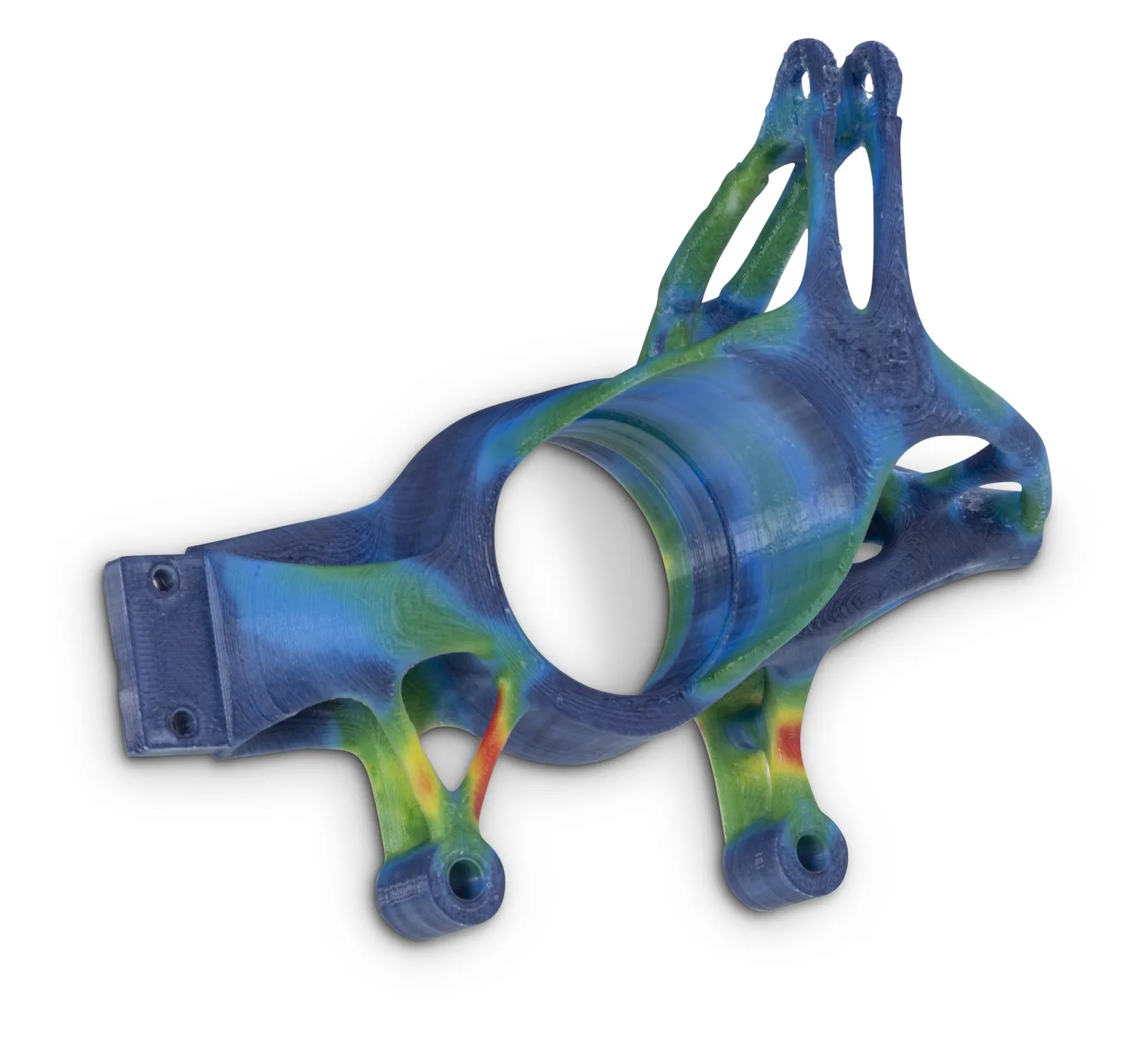
Bracket printed with APD in full color, colored by simulated stress

Full color

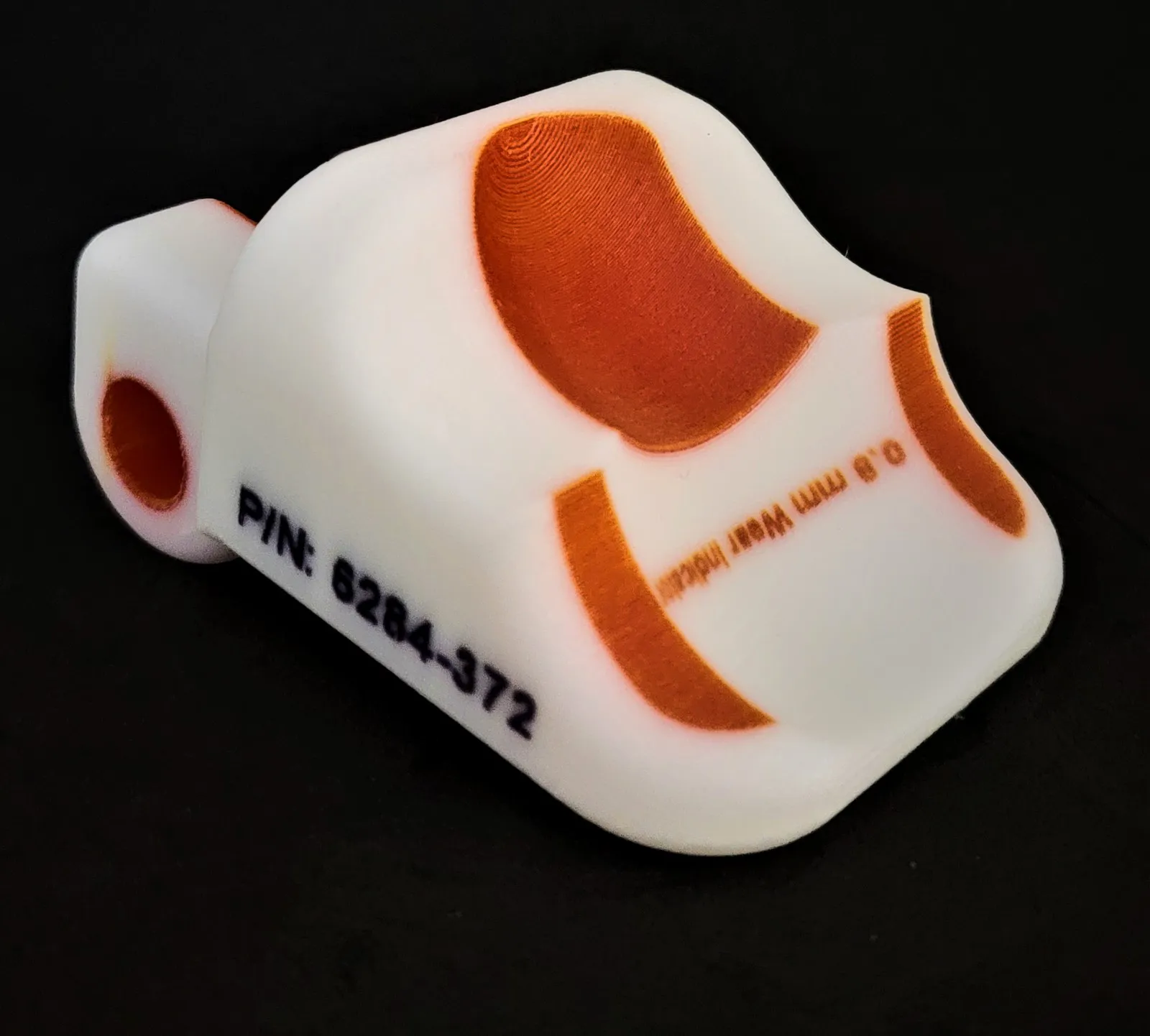
CMYK inks are placed voxel by voxel, so color follows the design: product colors, gradients, labels, or analysis results such as a stress map. Color can sit on the surface or inside the part, as in the wear-indicator part below.

Color shows simulated stress from the design analysis.
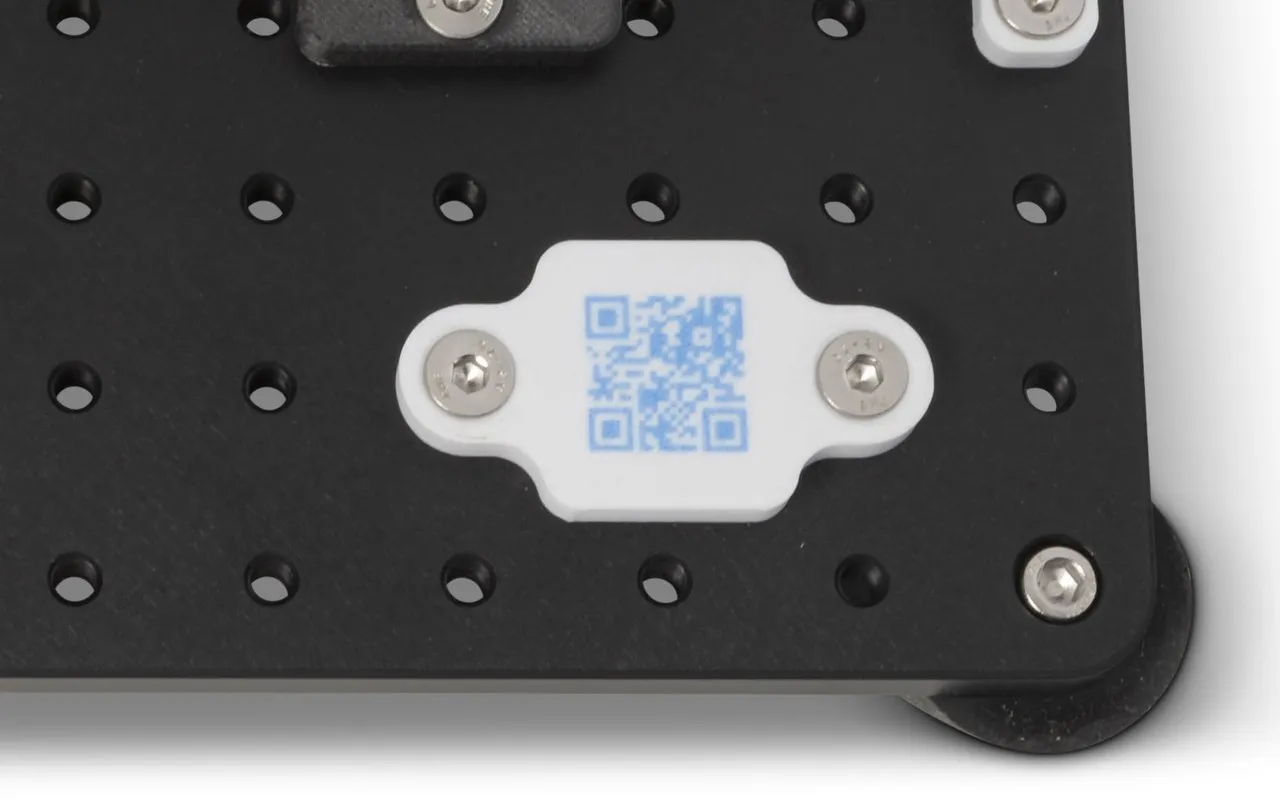
QR code embedded in a white APD part mounted on a fixture plate

Marking

Text, part numbers, instructions and QR codes are embedded a few voxels below the surface during the build. A thin skin of UV-absorbing polymer protects them from wear and fading.

partrelease ink between part and supports, same material

Release

Release ink is jetted where supports meet the part. Supports are printed in the same material as the part and separate cleanly, including under curved surfaces.

How same-material supports work
extruded layers, side viewink at each layer interface

Strength

Ink jetted at each layer interface improves bonding between extruded layers, which is usually the weak direction of an extruded part.

withoutwith surface ink

Surface

Ink applied at the outer edge of each layer reduces the stair-step texture that layered printing leaves on curved and sloped surfaces.

APD-printed white fixture with an orange wear-indicator layer below its contact faces and an embedded part number

Several capabilities in one part

This production fixture combines an embedded orange wear-indicator layer 0.8 mm below its contact faces with an embedded part number and wear-limit note, in one print with no assembly.

Release, in detail

Supports in the same material, released with ink

Extrusion printing usually leaves two choices for supports. Breakaway supports in the part's own material are printed with a gap, so the underside droops and needs finishing where they broke off. Soluble supports need a second material, a second nozzle and a dissolving step. APD prints supports in the same polymer, directly against the part, and jets release ink at the interface so the two do not fuse.

Cross-section, flat layers, layer height exaggerated. Hatching only marks which cells are support; part and supports are the same polymer.

One material

Supports are printed from the same filament as the part. No second support material, no second nozzle, no dissolving bath.

Full contact

Supports sit directly against the part with no air gap, so curved undersides and overhangs are fully supported while they print.

Removed by hand

Supports come off by hand along the ink line. In deep or enclosed areas, simple tools may help.

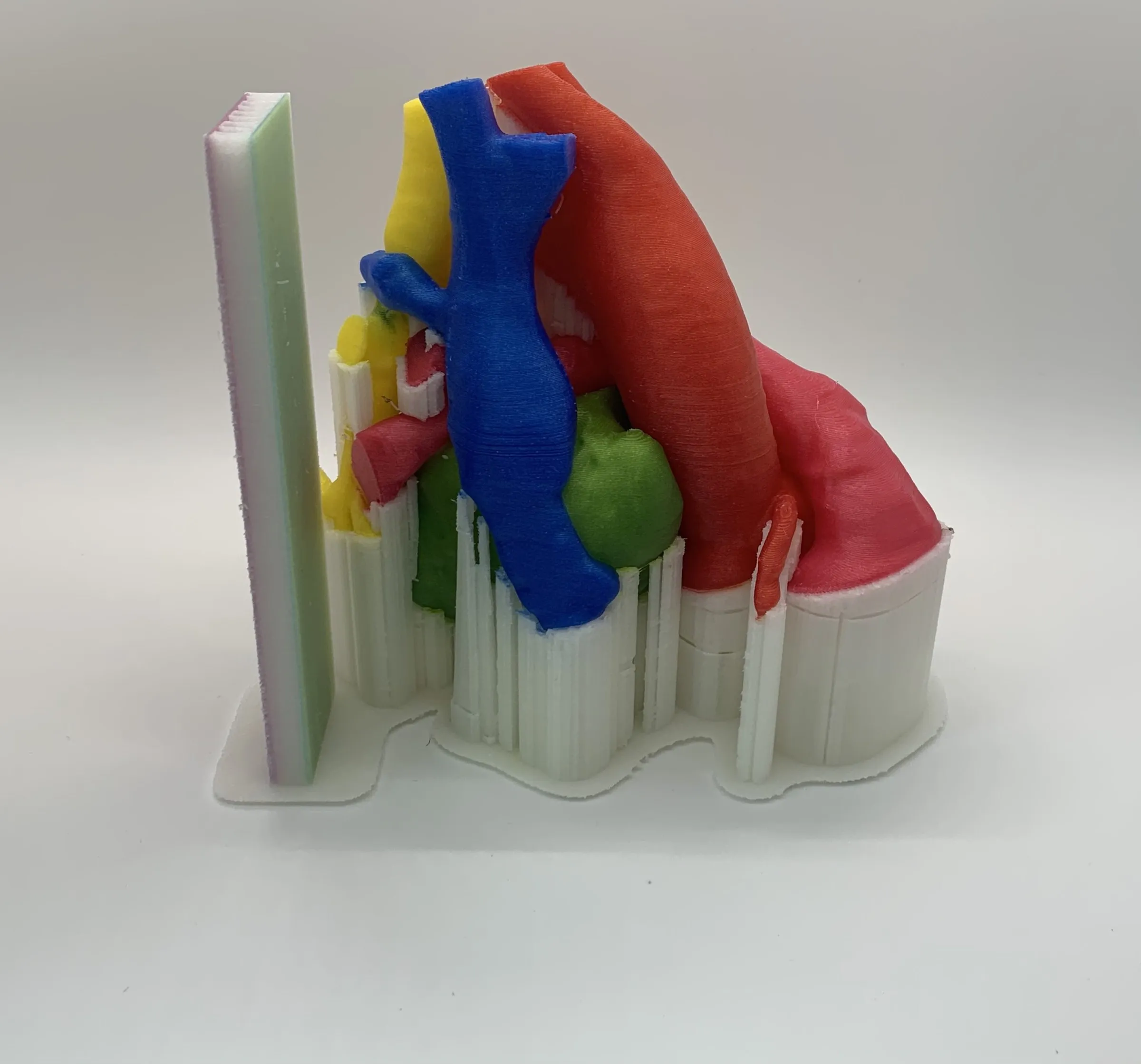
Full-color APD model still standing on white supports printed from the same polymer
On its supports. The supports print white because no color ink is jetted on them.
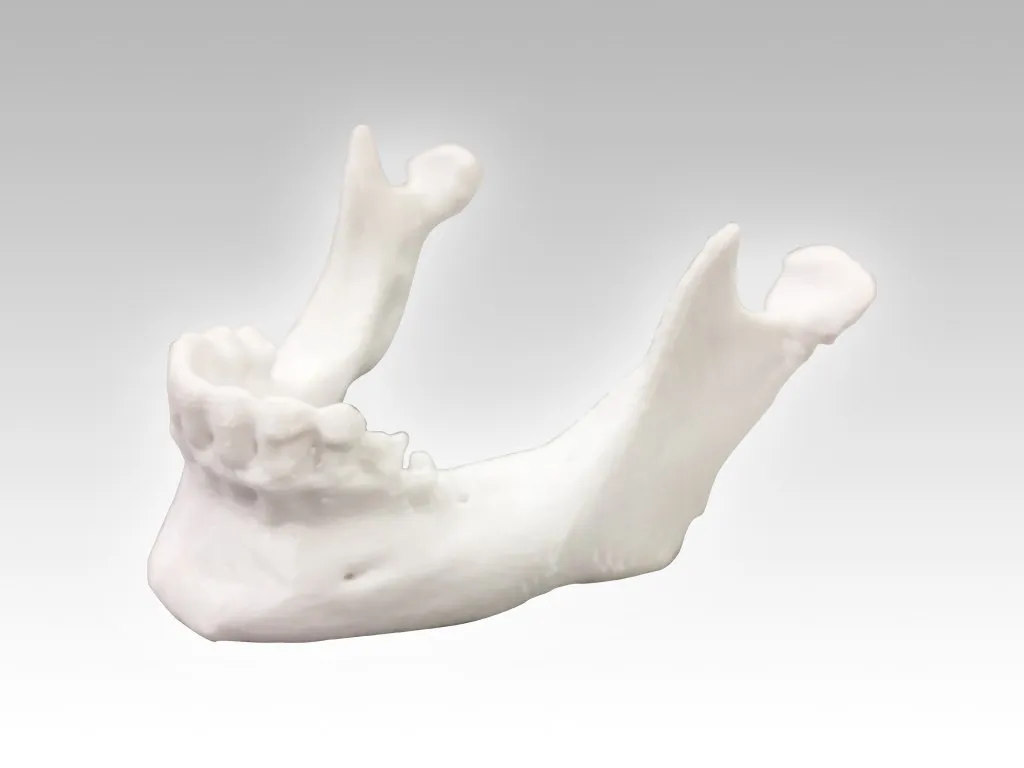
White APD-printed jaw model after its supports were removed
After release. A jaw model with its supports removed.

Watch supports come off a part in about six seconds Video from the RIZE archive, on YouTube.

Open for development

What the jetting step could place next

These applications use the same process and are open for joint development with partners.

Intellectual property

Four US patents

All four are assigned to Palitra LLC and claim a 2010 priority date.

PatentTitleGrantedKey subjectRelates to
US 9,227,366Process for fabrication of three-dimensional objects2016Alternating extruded polymer layers with printed ink layers, including a plasticizing ink selected by solubility parameter.Strength (layer bonding) and surface
US 10,265,910Process and apparatus for fabrication of three-dimensional objects2019The alternating build with heat or energy treatment of the ink or polymer layer.Process control for all inks
US 10,357,918Process and apparatus for fabrication of three dimensional objects2019System claims: ink embedded between extruded layers, with an energy treatment variant.Embedded color, marking and release
US 11,148,354Process and apparatus for fabrication of three dimensional objects2021A printed target pattern read by an optical sensor to align the extruder with the ink head.Registration between extrusion and jetting

Roadmap

Beyond FFF: from APD to AMD

APD is a jetting step added to a layer-by-layer process, not a single printer. That is what makes it licensable across processes.

Today

FFF with Rizium materials

The five demonstrated capabilities on extruded Rizium composites.

Next

High-performance FFF polymers

PEEK, Ultem and PPSF, with release ink for clean supports and embedded marking for traceability in medical and aerospace parts.

Roadmap

Powder bed processes (AMD)

In high-speed sintering and selective laser sintering, the jetting step adapts to powder layers. Here APD becomes Augmented Material Deposition (AMD), for polymers, metals and ceramics.

Throughout

Software that carries over

The voxel-based slicing approach is designed to move to new processes with minor changes.

Questions

APD in short

What is Augmented Polymer Deposition (APD)?

APD is a hybrid 3D printing process. An extruder deposits each layer of a thermoplastic part, and a piezo printhead jets functional inks onto that layer before the next one is added. The inks change the properties of the part where they land.

How is APD different from multi-material extrusion?

Multi-material extrusion switches between filaments. APD keeps one base polymer and changes its properties locally with jetted inks, at the resolution of the printhead, inside the same layer.

What can APD do today?

Five capabilities are demonstrated: full color, marking embedded below the surface, release ink for supports in the same material, ink that improves bonding between layers, and surface modification.

How does APD handle support structures?

Supports are printed from the same polymer as the part, directly against it, and release ink is jetted wherever a support layer meets the part. The ink keeps the two from fusing, so the supports come off by hand along the ink line. Deep or enclosed areas may need simple tools. No second support material or dissolving step is needed.

What is still in development?

Conductive traces and antennas, dielectric layers, surface chemistry, joining dissimilar polymers, tuned stiffness, and placement of biological or pharmaceutical agents are open for development with partners.

Is APD available for licensing?

Yes. Palitra licenses the APD process, patents and know-how for defined fields of use, usually after a feasibility study and joint development with the licensee.

Is APD limited to filament extrusion?

No. APD is a jetting step added to a layer-by-layer process. The roadmap extends it to high-performance polymers and to powder bed processes, where it becomes Augmented Material Deposition (AMD).

Evaluate APD for your product

Start with a feasibility study: we print your application with APD and test it against your requirements.

Discuss licensing